Unison and roll
A unison bend, the B string pushed up to the high E’s note, then a triplet roll down the box onto the major 3rd. Over A7 it slides into C♯ and ends on E.
E · 12/8 · 116 BPM · E7 · A7 · E7 · B7
Tab and neck with Pro
Stevie Ray Vaughan Style
Texas blues played hard: big bends, fast triplets, a wide, wild vibrato. 8 original licks over a real band — the first one is free to learn right here, on the neck and the tab.
Texas shuffle in E · Slow blues in G · Ballad in E
Free lick · play it here
Root, minor 3rd slid onto the major 3rd, then a hard bend from the ♭7 to the root in shuffle time. Over A7 it digs into its root.
E · 12/8 · 116 BPM · E7 · A7 · E7 · B7
116 BPM
Tap a note on the tab to hear it alone.
Bend the minor 3rd to the 4th. Like Albert King, he picks the minor 3rd on the high E and pushes it a whole step to the 4th, then lets it back down: the bluest bend in the box.
The unison bend. The B string bent up to the same note as the high E, both ringing. Until the bend arrives the two notes rub; when it does, they fuse into one big note.
Minor 3rd, then major 3rd. Over the I chord he slides from the minor 3rd onto the major 3rd: blue and sweet in one move, the sound of a Texas shuffle.
Dig in, then shake it. Every note picked hard, and long notes shaken with a wide, fast vibrato. Down low the sound gets thick and dark.
Listen to each one at full speed. The tab, the neck, the slower speeds and “Your turn” come with Pro.
A unison bend, the B string pushed up to the high E’s note, then a triplet roll down the box onto the major 3rd. Over A7 it slides into C♯ and ends on E.
E · 12/8 · 116 BPM · E7 · A7 · E7 · B7
Tab and neck with Pro
Bends the minor 3rd up to the 4th on the high E, falls down the box in fast sextuplets onto the root, then digs into the ♭7 of C7 and ends on its root.
G · 12/8 · 60 BPM · G7 · C7 · G7 · D7
Tab and neck with Pro
A slow bend from the 9th to the 3rd, a melody up to the sweet 6th, then over A two notes slid into and shaken together, like a chord on the tremolo bar.
E · 4/4 · 62 BPM · E · A · C♯m7 · B
Tab and neck with Pro
A hard bend from the 4th to the 5th in the low box, a walk down to the low root, then over C7 a jump up to its 3rd and a bend from F to G.
G · 12/8 · 60 BPM · G7 · C7 · G7 · D7
Tab and neck with Pro
Down low in E: the minor 3rd slid onto the major 3rd, a half-step bend, then over A7 three stabs on its root and 3rd and a wide vibrato on A.
E · 12/8 · 116 BPM · E7 · A7 · E7 · B7
Tab and neck with Pro
A slow melody low on the neck that rises to C♯, the sweet 6th, then over A two notes held and shaken together.
E · 4/4 · 62 BPM · E · A · C♯m7 · B
Tab and neck with Pro
A bend to the 5th on the high E, a bend from the ♭7 to the root on B, a walk down, then a climb up the C7 chord, note by note.
G · 12/8 · 60 BPM · G7 · C7 · G7 · D7
Tab and neck with Pro
All 8 on the neck and the tab, at half and ¾ speed, with “Your turn” — plus the licks of 7 more guitarists and the song analysis.
Original licks written for easyimprov in the style of each guitarist. They are not transcriptions of their recordings, and the guitarists aren’t affiliated with or endorsing easyimprov.
Sounds: recorded guitar notes by the Emily guitar from Karoryfer Samples (CC0), bent and slid note by note; bass and electric piano from the FluidR3_GM soundfont by Frank Wen (CC BY 3.0). Slower speeds are played slower, not stretched.
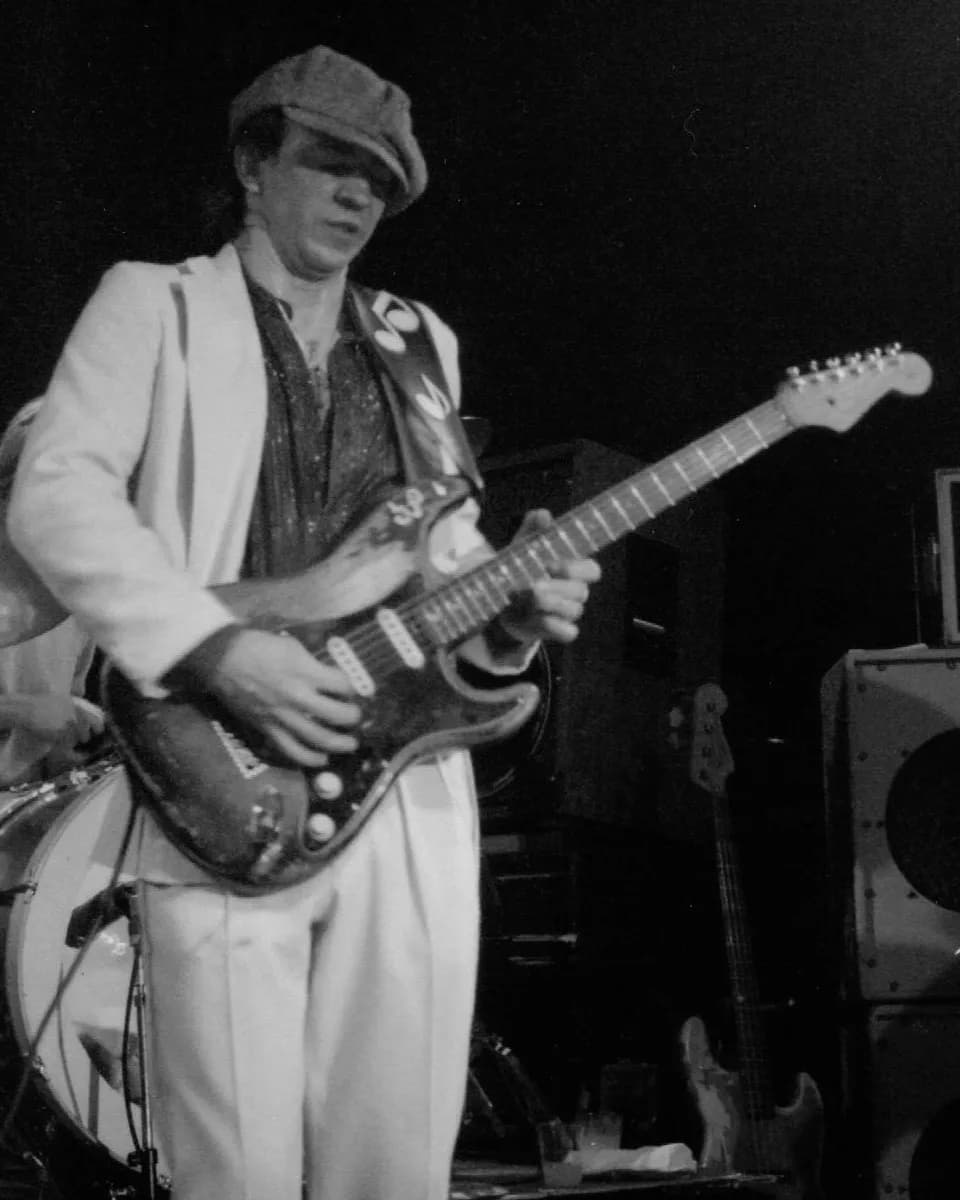
Photos from Wikimedia Commons, cropped and toned: Stevie Ray Vaughan by Bbadventure (CC BY-SA 4.0).
No sound on an iPhone? Check the silent switch.