High and floating
Up high: E bent to F♯ and answered by the same note fretted, a slide up to the root, then over A a slow bend from B to C♯, its 3rd.
Bm · 4/4 · 64 BPM · Bm · A · G · Em
Tab and neck with Pro
David Gilmour Style
Few notes and slow, singing bends, each one left to float on a long echo. 8 original licks over a real band — the first one is free to learn right here, on the neck and the tab.
Ballad in B · Ballad in G
Free lick · play it here
One slow bend from the ♭7 to the root, held and let down, a short walk, then over A a bend to E and a long C♯, its 3rd.
Bm · 4/4 · 64 BPM · Bm · A · G · Em
64 BPM
Tap a note on the tab to hear it alone.
Pick, wait, bend. He picks the note and waits before bending it, then pushes it up slowly, so you hear it travel to the target.
Bend to the chord’s 3rd. His long bends end on a note of the chord under them: B up to C♯, the 3rd of A; A up to B, the 3rd of G.
Space and echo. Few notes, long ones, and silence between them. The echo repeats each note a dotted eighth later and fills the space.
Bend and let down. He bends up, holds, and lets the string back down slowly: the way down is part of the melody too.
Listen to each one at full speed. The tab, the neck, the slower speeds and “Your turn” come with Pro.
Up high: E bent to F♯ and answered by the same note fretted, a slide up to the root, then over A a slow bend from B to C♯, its 3rd.
Bm · 4/4 · 64 BPM · Bm · A · G · Em
Tab and neck with Pro
Low in B minor: the 4th bent to the 5th and back, a slow walk to the 5th, then over A down to its root on the low E string.
Bm · 4/4 · 64 BPM · Bm · A · G · Em
Tab and neck with Pro
A slow bend from the 4th to the 5th low on the neck, a walk down to D, then over Dm its root and a slide up to A, its 5th.
Gm · 4/4 · 63 BPM · Gm · Dm · Cm · Gm
Tab and neck with Pro
Slides into the minor 3rd, bends the 4th to the 5th and back, falls to the root, then over Dm moves up and bends G to A, its 5th.
Gm · 4/4 · 63 BPM · Gm · Dm · Cm · Gm
Tab and neck with Pro
The minor 3rd bent to the 4th up high, a walk down to the root, then over Dm F bent to G and back, ending on A, its 5th.
Gm · 4/4 · 63 BPM · Gm · Dm · Cm · Gm
Tab and neck with Pro
Over Em7, A bent to B and back low on the neck, a short melody, then over G D bent to E and an end on B, its 3rd.
G · 4/4 · 60 BPM · Em7 · G · Em7 · A7
Tab and neck with Pro
Over Em7, D bent up to E and back, a walk down to E, then over G one slow bend from A to B, its 3rd, and a long B to close.
G · 4/4 · 60 BPM · Em7 · G · Em7 · A7
Tab and neck with Pro
All 8 on the neck and the tab, at half and ¾ speed, with “Your turn” — plus the licks of 7 more guitarists and the song analysis.
Original licks written for easyimprov in the style of each guitarist. They are not transcriptions of their recordings, and the guitarists aren’t affiliated with or endorsing easyimprov.
Sounds: recorded guitar notes by the Emily guitar from Karoryfer Samples (CC0), bent and slid note by note; bass and electric piano from the FluidR3_GM soundfont by Frank Wen (CC BY 3.0). Slower speeds are played slower, not stretched.
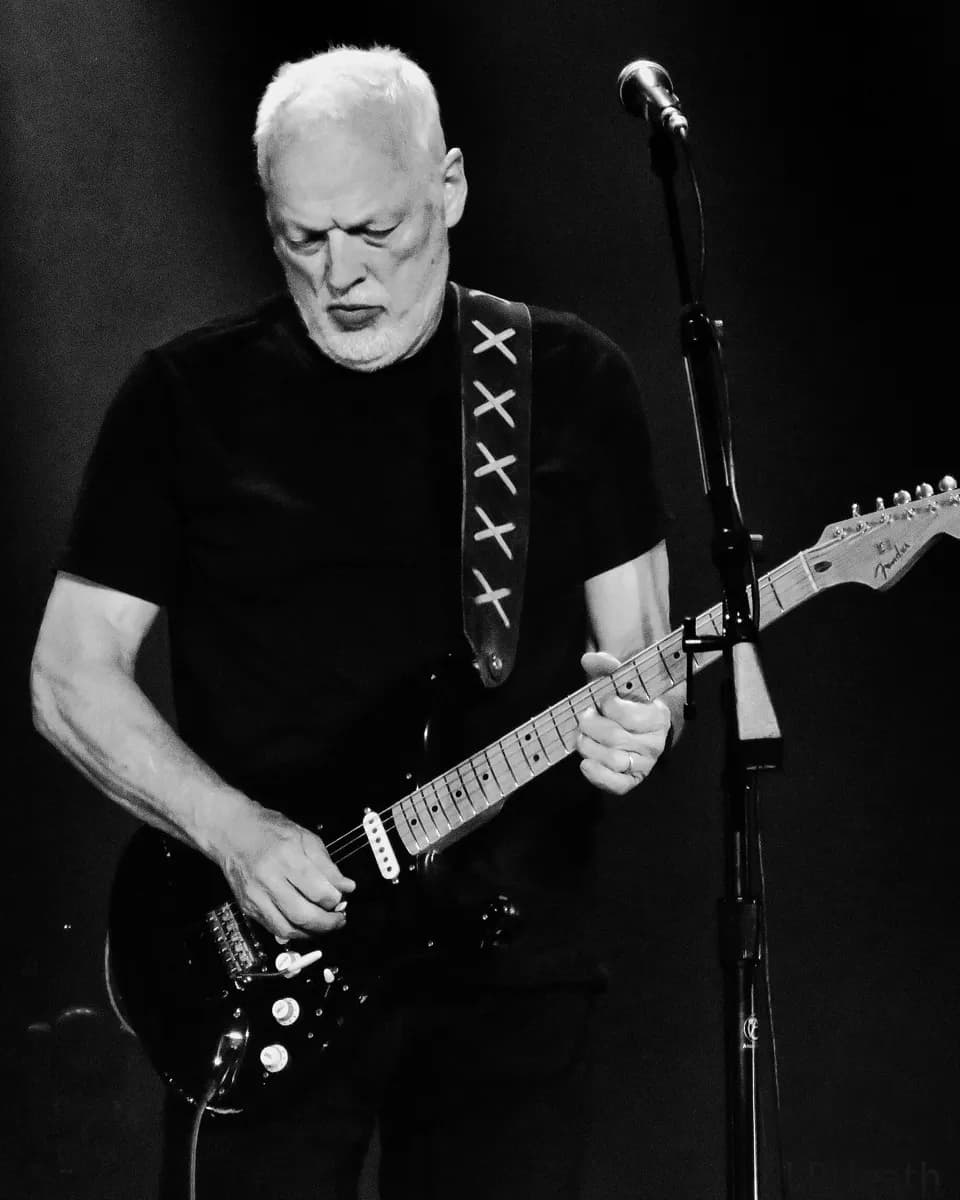
Photos from Wikimedia Commons, cropped and toned: David Gilmour by Lrheath (CC BY-SA 4.0).
No sound on an iPhone? Check the silent switch.